Rotary Plows and Flangers: How Colorado Railroads Fought the Snow
A steam rotary plow could cut a drift that ordinary plows could not. The record the Ledger found describes Colorado lines generally, not Pueblo’s.
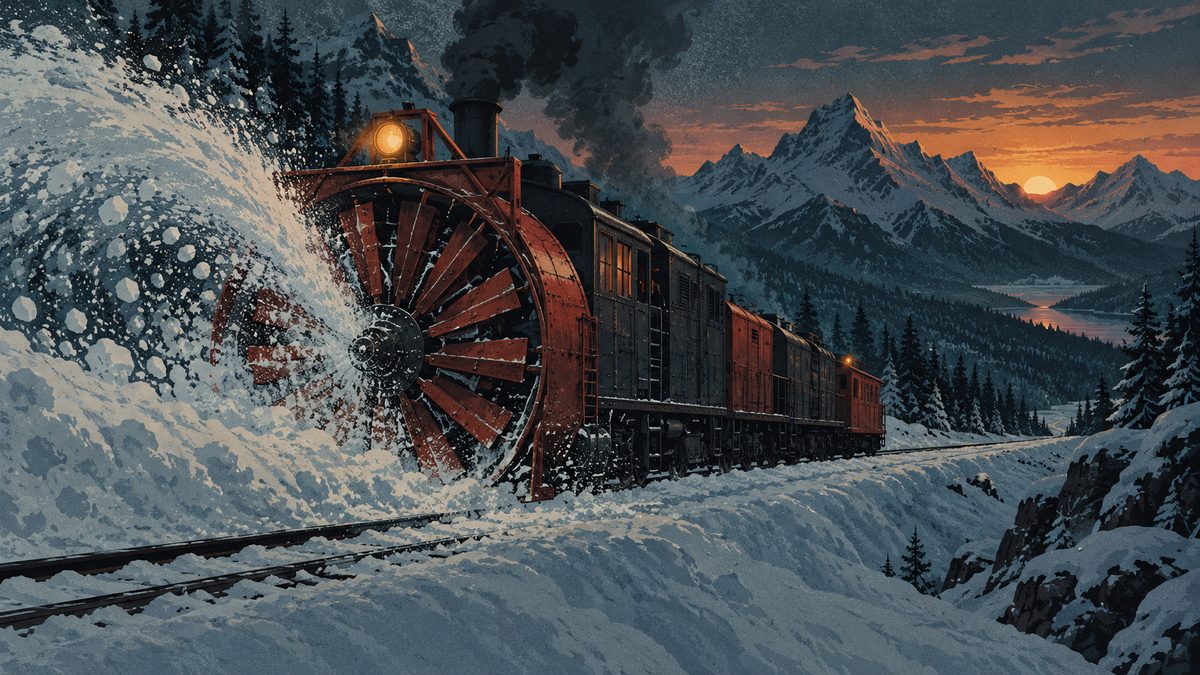
According to a Colorado Springs Gazette column by railroad historian Mel McFarland, a Denver & Rio Grande rotary snowplow had a steel drum nine feet in diameter, fitted with 12 rotating steel shovels and 18 two-edged steel knives. The column says the Rio Grande kept its lines open through the hard winter of 1899 and that a rotary kept the Palmer Divide line clear after severe blockades.
The Ledger could not tie these machines to Pueblo. Neither the rotary column nor the other sources below mention the city.
How a rotary worked
The Colorado Railroad Museum describes the principle plainly. A rotary’s circular blades chop up the snow and throw it clear of the tracks. A steam engine inside the plow spins the blades, and the plow cannot move itself. Locomotives must push it.
The museum adds that rotaries are expensive to operate and maintain and are used only for the most severe conditions. McFarland’s column gives the drive cylinders as 17 inches in diameter with a 22-inch stroke.
The flanger
A plow on the front of a locomotive clears snow from the top of the rail. Ice packed into the flangeways, the grooves where the wheel flanges ride, needs another tool.
According to Jerry Day in Railfan & Railroad (web version posted December 27, 2022), the Denver & Rio Grande developed and patented a device in 1885 to clear ice and snow from the flangeways. The December 12, 1885, Gunnison Review Press reported on the machine, calling it “the snow flanger.” Day says the railroad built 10 narrow gauge flangers at its Burnham Shops in Denver and acquired a secondhand one.
What survives
Wikipedia, citing a railfan reference site, lists two Rio Grande narrow gauge rotaries, OM and OY, as owned by the Cumbres & Toltec Scenic Railroad in Chama, New Mexico. It says OY last ran in 1997 and was restored for a February 2020 photo event. Sources the Ledger saw disagree on OM’s build date, so the Ledger gives none.
What we don’t know
- Whether any machine described here worked near Pueblo. The Palmer Divide column does not name the city.
- Which line rotary No. 318 served. The Colorado Railroad Museum page headed “Denver & Rio Grande Western Steam Locomotive No. 318 (N)” describes a “C&S rotary snowplow” that “operated over a number of Colorado mountain lines from 1899 until 1965.” Its photo caption and data sheet say Colorado & Southern No. 99201. The page does not explain the mismatch, and the Gazette caption repeats the same wording.
- Whether the Rio Grande’s Palmer Divide rotary was one of the narrow gauge Leslie machines that survive. The Ledger found nothing that says so.
Pueblo railroad records, or Rio Grande equipment rosters for the Pueblo–Denver line, would be the place to look for a local link.